


Unmarried, Unafraid: Decoding Child Custody Rights in India
Unmarried, Unafraid: Decoding Child Custody Rights in India
I. The Modern Indian Family: A New Legal Landscape
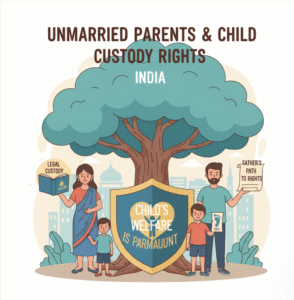
Families, as we know, are evolving at warp speed. It seems our laws are in a perpetual game of catch-up, particularly when it comes to the rising number of unmarried parents in India. Navigating the legal terrain can feel like deciphering an ancient script, but fear not. Custody rights for unmarried parents aren’t a legal black hole, but rather a distinct path being paved with progressive interpretations. The central theme? The child’s welfare is paramount, the ultimate king in this complicated game.
II. Custody Jargon Bust: What Do All These Terms Mean?
Legal terminology often sounds like another language. So, let’s demystify some key terms. It’s not just about “who gets the kid.”
- Physical Custody: Simply put, where the child lives day-to-day. Think of it as the primary residence for care.
- Legal Custody: This is about who makes the significant life decisions – education, healthcare, religious upbringing.
- Guardianship: A broader term encompassing the overall responsibility for the child’s well-being, often tied closely to custody.
- Sole vs. Joint: One parent holding all the cards versus both parents collaborating in harmony.
III. The Unmarried Mother: India’s Unsung Legal Guardian
Indian law, traditionally, has leaned towards granting mothers automatic primary custody and guardianship, especially for younger children. Why? A societal view of mothers as primary caregivers, reinforced by legal precedent. But there is more to it, an important Supreme court Judgement.
The Power of Privacy: A Landmark Win!
The Supreme Court ruling in ABC v. State (NCT of Delhi) (2015) was a game-changer. It declared that an unwed mother can be the sole guardian of her child without the father’s consent, or even disclosing his identity on the birth certificate. This protects the mother’s privacy and, more importantly, prioritizes the child’s best interests. This judgement is often discussed on legal blogs.
Also, remember that mothers can claim maintenance for their child (and sometimes themselves) from the father, as per the new Bharatiya Nagarik Suraksha Sanhita, 2023 (BNSS).
Moreover, don’t overlook the Protection of Women from Domestic Violence Act, 2005, which offers protection to women in live-in relationships.
IV. The Unmarried Father: A Path to Parenthood Rights
Fathers don’t automatically get guardianship rights like mothers, but there are definitely avenues for them to seek custody or visitation.
First things first: paternity needs to be established. This can be done verbally, in writing, or through a DNA test. Next, the father must petition the court under the Guardians and Wards Act, 1890, to formally seek custody or visitation rights.
Interestingly, several High Courts have taken a progressive stance. The Calcutta High Court has affirmed a father’s right to custody, even if unmarried. The Delhi High Court has emphasized that a father can be granted custody if he can provide a better upbringing, always keeping the child’s welfare at the forefront. Also, it’s worth noting that unmarried fathers are legally obligated to provide financial support for their children.
V. The Child’s Compass: “Welfare is Paramount”
The overarching principle is, and always will be, the child’s welfare. This trumps all other considerations in court decisions. What factors do the courts consider? The child’s age and gender (mothers are often favored for very young children), the child’s wishes (if they are old enough, typically 9+), parental fitness and stability (character, financial security, emotional bond), and continuity (minimizing disruption to the child’s life). The Guardians and Wards Act, 1890 (a secular law) and the Hindu Minority and Guardianship Act, 1956 (for Hindus, with evolving interpretations), form the legal pillars in these matters.
VI. High Court Huddle: Key Judgments Shaping the Future
The Allahabad High Court is breaking down what it sees as “patriarchal bias” in Hindu law (HMGA Section 6), advocating for more equitable interpretations and granting protection to live-in couples with children. The Chhattisgarh High Court consistently prioritizes the child’s welfare, even if it means overturning lower court orders. The Supreme Court has also taken a flexible stance, acknowledging that custody orders aren’t set in stone and can be changed if they negatively impact a child’s mental health. Emphasis is being placed on fostering parent-child relationships, even when the parents are separated.
VII. Planning for Peace: Custody Agreements & Future Rights
Unmarried parents can create formal custody agreements that cover visitation schedules, shared responsibilities, and financial support. While not always legally binding without court approval, they serve as excellent roadmaps. Joint guardianship is also an option, provided that the parents can cooperate for the sake of the child’s well-being. And here’s some reassuring news: children born to unmarried parents are considered legitimate and have inheritance rights to both self-acquired and (with certain caveats stemming from Revanasiddappa v. Mallikarjun, 2023) ancestral property.
VIII. The Road Ahead: Challenges & Global Comparisons
We can’t ignore the societal stigma that unmarried parents (especially mothers) sometimes face, despite legal advancements. The legal process can also be complex and time-consuming, often requiring the assistance of a skilled lawyer.
It’s also insightful to look at how other countries handle these issues. In the UK, US, Canada, and Australia, child welfare is also paramount, but the initial legal pathways for fathers may differ. The Indian legal landscape is constantly adapting, moving toward more equitable parental rights and exploring shared parenting models.
IX. Your Next Steps: Knowledge is Your Superpower!
If you’re facing a custody battle as an unmarried parent, don’t go it alone. Seek legal counsel from family law experts. Always keep the child’s well-being at the heart of all decisions. And stay informed by consulting reputable legal resources.
Disclaimer: This blog post provides general information and should not be considered legal advice. Always consult a qualified legal professional for your specific situation.
Ahmed Jamal Siddiqui
Advocate High Court
Contact : 9999077653