

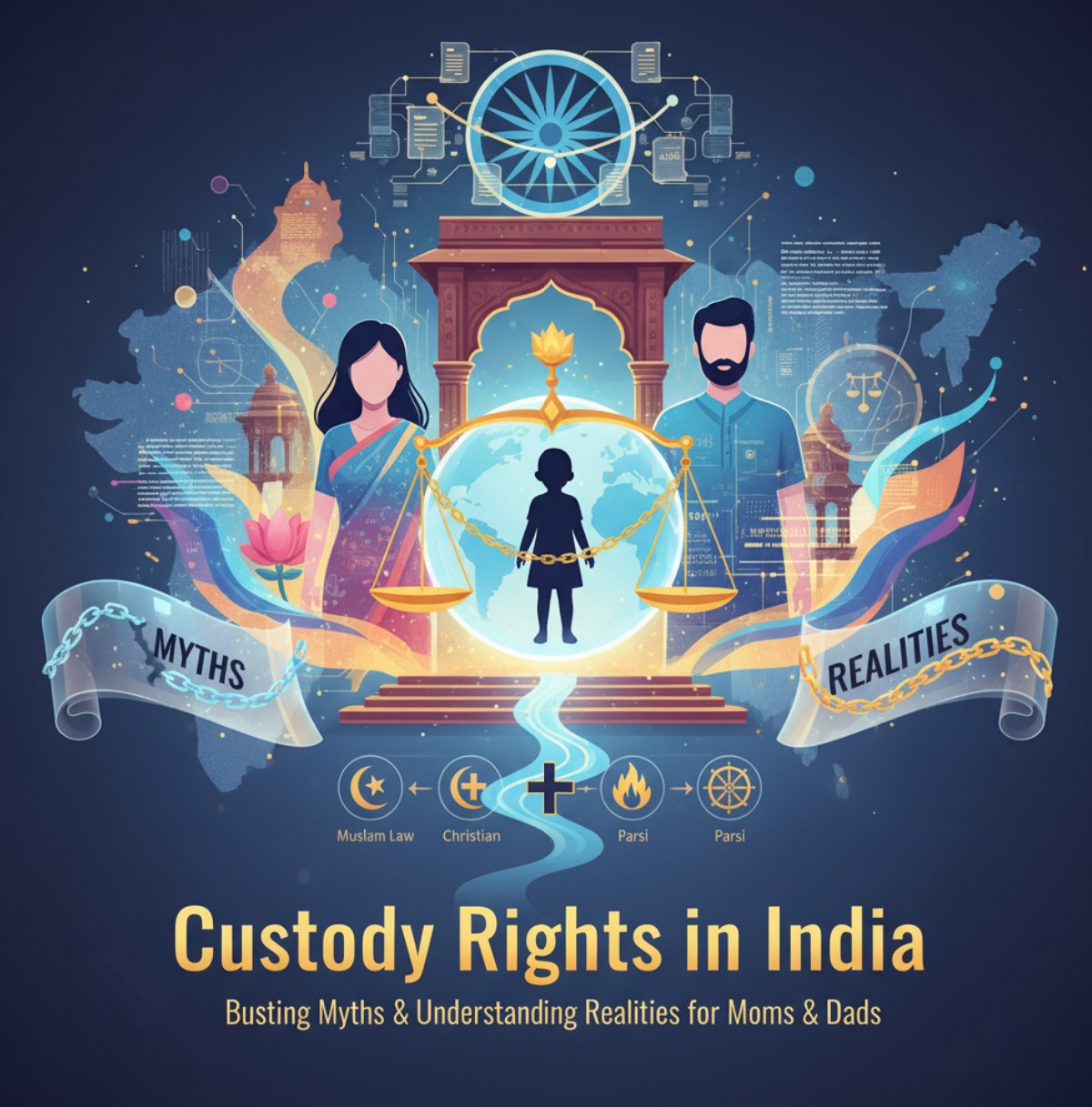
Custody Rights in India: Busting Myths & Understanding Realities for Moms & Dads
Custody Rights in India: Busting Myths & Understanding Realities for Moms & Dads

I. Introduction: Decoding Child Custody in India
The emotional labyrinth of child custody – it’s a space riddled with anxiety, uncertainty, and often, misinformation. What’s fact, and what’s pure fiction, especially when you’re knee-deep in the legal process? Navigating this landscape in India feels like trying to decipher an ancient script with a modern interpreter.
India’s child custody landscape is a fascinating blend of ancient traditions and modern law. It’s a complex interplay of personal laws dictated by religion, secular laws applicable to all, and a constantly evolving understanding of children’s rights. But through all the legal jargon and court procedures, there’s one guiding principle, a true north star in this confusing sky.
The Golden Rule: The “Welfare of the Child” is the ultimate guiding star for all decisions. It’s not about who “deserves” custody or who’s the better parent in the traditional sense. It’s about what arrangement best serves the child’s physical, emotional, and psychological well-being. It’s a holistic assessment, not a scorecard.
II. The Legal Canvas: Acts & Laws Governing Custody
Let’s paint a picture of the legal landscape with broad strokes, looking at the key legislation that governs child custody in India.
A. The Grand Old Laws
- Guardians and Wards Act, 1890 (GWA): This is the secular heavyweight, the law that potentially applies to everyone residing in India, regardless of their religious affiliation. Think of it as the foundational bedrock upon which other laws build.
- The court’s primary job under the GWA is to appoint guardians for a minor’s person or property. The singular focus is always, relentlessly, on keeping the child’s welfare front and center.
- Blog Reference: As highlighted by ipleaders.in, the GWA provides a comprehensive framework for guardianship matters, emphasizing the child’s best interests.
- Hindu Minority and Guardianship Act, 1956 (HMGA): This Act provides a personal touch for Hindus, Sikhs, Jains, and Buddhists. It delves into who is considered the natural guardian of a minor child.
- Initially: The Act designated the father as the natural guardian, followed by the mother. This felt inherently unequal, didn’t it?
- The Twist: There’s a vital proviso to Section 6: for children under five, the mother is usually the preferred guardian. This acknowledges the unique bond and care infants and toddlers require, though it’s by no means a rigid rule.
- Supreme Court’s Game Changer: The landmark case of Gita Hariharan v. Reserve Bank of India (1999) reshaped the understanding of natural guardianship. The Supreme Court ruled that the mother can indeed be the natural guardian even if the father is alive but is absent, incapable, or otherwise not taking an active role in the child’s life. It was a significant step toward gender equality within the legal framework.
- Blog Reference: As reported by ksandk.com, Gita Hariharan case was a pivotal moment in recognizing the equal rights of mothers as natural guardians.
B. Other Important Players (Personal Laws)
- Muslim Law: This system incorporates Hizanat rules, which grant the mother custody of boys until the age of seven and girls until they reach puberty. After these ages, the father typically becomes the preferred guardian.
- Christian Law: In cases involving Christians, the Indian Divorce Act, 1869, comes into play, providing a framework for resolving custody disputes during divorce proceedings.
- Parsi Law: The Parsi Marriage and Divorce Act, 1936, governs custody matters within the Parsi community.
- Interfaith/Court Marriages: The Special Marriage Act, 1954, often works in conjunction with the Guardians and Wards Act, 1890, to address custody issues arising from interfaith or court marriages.
- Blog Reference: According to legalkart.com and advocatekhoj.com, understanding these diverse legal frameworks is crucial for navigating custody battles in India.
III. Myth vs. Reality: Who Really Gets Custody?
It’s time to dissect some common misconceptions that cloud people’s judgment during custody battles.
- Myth 1: Mom always gets custody!
- Reality: Absolutely not always. While mothers often receive preference, especially for very young children (under 5), this isn’t an automatic victory. It stems from Section 6 of the HMGA and a generally accepted societal understanding of a mother’s role in early childhood. However, the court’s ultimate concern remains the child’s welfare above all else.
- Roxann Sharma v. Arun Sharma (2015) firmly reiterated this principle, emphasizing that while the mother’s role is significant for children under five, the child’s well-being is paramount.
- Legal Blog Insight: pinklegal.in rightly points out that while there is a preference for mothers with young children, it is by no means absolute.
- Myth 2: Dads can’t get custody of minor children.
- Reality: Utter nonsense! Fathers possess equal rights under the law. Courts meticulously assess both parents’ capabilities to offer a stable, loving, and nurturing home environment. For older children (often 5+ or 9+), fathers stand a strong chance, especially if they demonstrate a superior environment for the child’s overall development. It’s worth noting that Section 6 of the HMGA designates the father as the natural guardian for children aged 5-18.
- Blog Reference: indialawoffices.com emphasizes the equal rights of fathers in custody matters, urging them to actively participate in their children’s lives.
- Myth 3: More money = automatic custody.
- Reality: Sorry to burst that bubble! While financial stability is undoubtedly a factor, it’s far from the only determinant. Emotional bond, ethical upbringing, access to quality education, and the parent’s overall character weigh significantly more in the court’s assessment.
- High Court Judgment Spotlight: Gaurav Nagpal v. Sumedha Nagpal (2008) – the Supreme Court explicitly stated that financial superiority cannot be the sole deciding factor in custody cases.
- Myth 4: Custody orders are set in stone.
- Reality: Not at all. These orders are designed to be flexible, adapting to the child’s evolving needs and changing family circumstances. Courts retain the power to modify custody arrangements if there’s a significant shift in circumstances or if it’s deemed beneficial for the child’s welfare.
- Myth 5: Grandparents are out of luck.
- Reality: Not necessarily. In situations where parents are deemed unfit, deceased, or otherwise absent, courts can grant custody to grandparents or other close relatives who can provide a stable and loving home.
IV. What Courts Really Look At: The Child’s Best Interest Above All Else
A. Beyond Gender: A Holistic Approach
- Paramountcy of Child’s Welfare: This is the bedrock, the unwavering foundation upon which all custody decisions are built. The court will consider every aspect of the child’s well-being – physical, emotional, mental, and ethical development. It’s a 360-degree assessment.
- In Nil Ratan Kundu v. Abhijit Kundu (2008), the Supreme Court underscored the importance of a “human touch” in custody cases, emphasizing that rigid legal principles should not overshadow the child’s emotional needs.
- Gender Neutrality: High Courts are progressively moving away from outdated biases, recognizing the equal roles and capabilities of both parents.
B. Key Factors in Decision Making
- Stable & Nurturing Home: Which parent can provide a safer, more consistent, and loving environment?
- Parent-Child Bond: The strength and quality of the emotional connection with each parent.
- Child’s Wishes (if old enough!): Usually, for children aged 9 and above, their preferences are given due consideration. The older and more mature the child, the greater weight their opinion carries.
- Education & Ethical Upbringing: Who is best positioned to ensure access to quality education and instill strong moral values?
- Health Needs: The ability to provide for the child’s physical, emotional, and psychological well-being.
- No Abuse Zone: Any history of abuse, neglect, or domestic violence is a significant red flag and can heavily influence the court’s decision.
- Keeping Siblings Together: Courts generally strive to avoid separating siblings, recognizing the importance of their bond and mutual support.
- Parental Character & Mental Stability: The overall fitness and mental well-being of each parent are carefully evaluated.
- Blog Reference: According to legalshiksha.com and sheokandlegal.com, a holistic assessment of these factors is crucial in determining the child’s best interests.
C. High Court Wisdom in Action
- Karnataka High Court, Delhi High Court, etc.: Across various High Courts in India, there is a consistent and unwavering focus on the child’s welfare as the paramount consideration.
- For example, a 2025 Supreme Court case reviewed a High Court order where a child’s mental health was severely impacted by separation from a parent, highlighting the need for adaptability and sensitivity in custody decisions.
- Landmark Case Reminder: Somprabha Rana v. State of Madhya Pradesh (2023) saw the Supreme Court reverse a High Court order that automatically restored custody to the father, reaffirming that the child’s welfare must always take precedence over rigid legal interpretations.
- Blog Reference: As observed by altacit.com and thelegalcrusader.in, these judicial pronouncements underscore the judiciary’s commitment to safeguarding children’s rights and well-being in custody disputes.
V. Beyond Custody: Guardianship, Visitation & Types of Arrangements
A. Guardianship vs. Custody: What’s the Difference?
- Guardianship: Encompasses the broad legal authority and responsibility to make crucial decisions concerning a child’s person or property. This includes matters like education, healthcare, and financial management.
- Custody: Refers to the day-to-day care, control, and physical living arrangements of the child.
- (Fun Fact): It’s entirely possible for the father to be appointed as the guardian of a child’s property while the mother is granted custody of the child’s person, especially if the child is under the age of five.
B. Types of Custody You Might Hear About
- Physical Custody: Determines where the child resides on a daily basis.
- Legal Custody: Grants the right to make significant life decisions for the child, such as those related to education, healthcare, and religious upbringing. This is often shared between parents.
- Joint Custody (Shared Parenting): An increasingly favored arrangement where both parents share parenting responsibilities, including time and decision-making. Courts are actively encouraging this approach whenever feasible.
- Sole Custody: Grants all custody rights to one parent, typically reserved for extreme cases where the other parent is deemed unfit or poses a risk to the child’s well-being.
- Third-Party Custody: Involves granting custody to grandparents, other relatives, or foster parents when neither parent is capable of providing adequate care.
C. The Non-Custodial Parent’s Lifeline: Visitation Rights
- Courts almost invariably grant visitation rights to the non-custodial parent, ensuring that children maintain a meaningful bond with both parents, unless there are compelling reasons to believe that such contact would be harmful to the child.
- High Court Directive: Jyoti Priya v. Paul Goodwin emphasized the importance of avoiding the separation of a minor child from either parent during legal proceedings if such separation could be detrimental to the child’s well-being.
VI. Societal Perceptions & The Road Ahead: Evolving Trends
A. Battling Old Mindsets
- Societal Bias: Traditional Indian society often perceives the mother as the primary caregiver and the father as the provider. This ingrained bias can influence perceptions and expectations, although it’s gradually shifting.
- Patriarchal Hangover: Historical laws and societal norms have sometimes favored fathers in custody matters, but courts are actively challenging these outdated notions and promoting gender equality.
B. Challenges Faced by Families
- Emotional Rollercoaster: Custody battles can be emotionally traumatic for all involved, leading to anxiety, behavioral issues, and feelings of insecurity for children.
- Parental Alienation: A harmful phenomenon where one parent deliberately poisons the child’s mind against the other parent, undermining their relationship.
- Long Legal Battles: Custody cases can be lengthy, costly, and emotionally draining, placing immense strain on families.
- Inconsistent Application: The “best interest” principle, while well-intentioned, can sometimes be interpreted differently by lower courts, leading to inconsistencies in custody decisions.
C. The Future is Child-Centric
- Judicial Activism: Courts are taking a proactive role in safeguarding children’s rights, constantly refining laws and procedures to prioritize their well-being.
- Mediation & Counseling: Encouraging parents to explore mediation and counseling as a means of finding common ground and resolving custody disputes amicably, outside of the adversarial courtroom setting.
- Unwed Mothers’ Rights: The landmark ruling in ABC v. State (NCT of Delhi) affirmed that unwed mothers can be the sole legal guardians of their children, granting them the same rights and protections as married mothers.
- Adaptable Justice: Courts are increasingly blending personal laws with secular statutes, demonstrating a willingness to discard outdated legal principles if they are detrimental to the child’s well-being.
- Blog Reference: According to theestablished.com and legalassist.co.in, the future of child custody in India lies in a child-centric approach that prioritizes their rights and well-being above all else.
VII. Conclusion: A Balancing Act for a Brighter Future
- Recap: India’s custody laws are admittedly complex and nuanced, but they are fundamentally united by one overriding principle: the child’s welfare reigns supreme.
- Final Thought: Navigating the intricacies of child custody is a challenging journey for parents and the legal system alike. However, by constantly striving for the best outcomes for India’s children, we can pave the way for a brighter and more equitable future.
Disclaimer: This blog post provides general information and should not be considered legal advice. Always consult a qualified legal professional for your specific situation.

Ahmed Jamal Siddiqui
Advocate High Court
Contact : 9999077653