


Temporary vs. Permanent Child Custody in India: Your Parent’s Playbook for the Legal Maze!
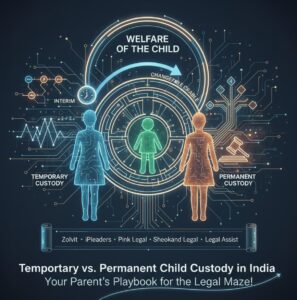
Temporary vs. Permanent Child Custody in India: Your Parent’s Playbook for the Legal Maze!
I. The Emotional Rollercoaster: When Custody Comes Up
Divorce or separation is tough enough, isn’t it? But when kids are involved, child custody becomes the ultimate, heart-wrenching puzzle. As parents, we all believe we know what’s best, but what does “best” *really* mean in the cold, hard eyes of Indian law? I often ponder this myself…
We’re breaking down the two main types of child custody in India – temporary and permanent – and why understanding them is absolutely crucial for securing your child’s future.
The Golden Rule: Spoiler alert! Everything – everything – revolves around the “Welfare of the Child.” This isn’t just some lofty legalese; it’s the very heartbeat of every custody decision in India. Zolvit and many others in the legal fraternity correctly emphasize this, and frankly, it’s the only thing that truly matters.
II. Temporary Custody: The Legal “Holding Pattern”
What is temporary custody, anyway? Think of it as a provisional arrangement, or an interim custody. It’s the court’s way of ensuring your child is adequately cared for while the main parental dispute (like a protracted divorce) is still playing out in the courts. These things can drag on for years, so a quick, sensible solution for the children involved becomes utterly vital.
Why it matters: It provides immediate stability – where the child lives, who makes the essential day-to-day decisions concerning them, and who gets visitation rights. Without this, we’d be sunk.
Legal Backing: Section 12 of the Guardians and Wards Act, 1890, is what gives courts the power to make these interim orders, and Section 26 of the Hindu Marriage Act, 1955, allows the same for Hindu parents during divorce proceedings. iPleaders extensively covers this whole process; they’re worth a look.
Fun Fact: Interim custody can even be granted to someone who isn’t a parent if the court deems that arrangement to be in the child’s best interests! Who would have thought, eh?
III. Permanent Custody: The Long-Term Game Plan
What is permanent custody? Well, this is the big one, the final decision, so to speak. Once your divorce or separation case is finally resolved, the court issues a “permanent” custody order. This order outlines exactly who has continuous responsibility for the child until they turn 18, which includes their upbringing, education, and healthcare.
The “Permanent” Catch: Here’s where things get tricky. No custody order is truly permanent! As Lawyer In Noida is always quick to point out, courts can always modify orders if there’s a significant change in circumstances that demonstrably affects the child’s welfare. So, nothing is ever really set in stone.
IV. Temporary vs. Permanent: Spot the Differences
- Duration: Temporary custody is for the legal journey itself; permanent custody is for the destination (until the child turns 18, or until things change, of course!).
- Finality: Temporary orders are like drafts, always subject to change. Permanent orders are supposed to be the final verdict, even though they can be appealed or modified later on.
- Purpose: Temporary custody is all about immediate stability for the child. Permanent custody is focused on their long-term growth and development.
- Who gets it? This is interesting: the parent who gets temporary custody might not be the one who ultimately gets permanent custody, especially if circumstances shift dramatically during the lengthy legal process.
V. India’s Legal Compass: Navigating Custody Laws
- The Umbrella Act: The Guardians and Wards Act, 1890, is the big secular law that applies to absolutely everyone. It gives courts broad powers to appoint guardians and determine custody, and it can even override personal laws if they clash with the child’s welfare. Remarkable, isn’t it?
- Personal Touches:
- Hindus: Hindu Marriage Act, 1955, and Hindu Minority and Guardianship Act, 1956. Traditionally, fathers were considered the natural guardians, but mothers are often preferred for children under five, and our courts are now refreshingly gender-neutral, focusing intently on welfare. Legal platforms like Pink Legal delve deep into these specifics.
- Muslims: Governed by Muslim Personal Law, where mothers typically have “hizanat” (custody) until a certain age.
- Christians & Parsis: Indian Divorce Act, 1869, and Parsi Marriage and Divorce Act, 1936, come into play here, often alongside the GWA.
- Interfaith/Court Marriages: The Special Marriage Act, 1954, covers these unique scenarios.
- The Paramount Principle: No matter the religion or which personal law applies, the “welfare principle” always takes precedence. Sheokand Legal rightly highlights this as the very cornerstone of all decisions.
VI. What Courts Really Look For: The “Best Interests” Blueprint
- It’s Not About You, It’s About Them: Courts aren’t picking favorites between parents; they’re looking for what genuinely benefits the child in the long run.
- Key Factors (like a checklist for judges):
- Child’s Age & Gender: Mothers are often preferred for children under 5 (the so-called “tender years doctrine”), but this isn’t a rigid rule if the mother is deemed somehow unfit.
- Child’s Voice: For older, more mature children (generally around 9-10 years and above), their wishes are certainly considered, though not as the sole determining factor, of course.
- Parental Fitness Report:
- Emotional Bond: Who does the child have a stronger, healthier connection with?
- Financial Stability: Can the parent adequately provide for their needs (education, healthcare)? But money isn’t everything!
- Moral Character & Health: Any history of abuse, neglect, or substance abuse? A parent’s mental and physical health certainly matters.
- Stability: Who can offer a more consistent, peaceful environment? Courts absolutely hate disruption!
- Willingness to Co-parent: Can the parents put their differences aside, at least for the sake of the child?
- Education & Healthcare: Ensuring continuity and high quality in these crucial areas.
- Sibling Unity: Courts generally prefer to keep siblings together, which makes perfect sense.
- Insights from Legal Assist: They simplify these complex factors, emphasizing how “welfare” goes beyond mere money.
VII. High Courts Weigh In: Real-World Rulings and Judicial Wisdom
- Gujarat High Court (April 4, 2025): Emphasized that custody decisions are inherently temporary and should never be weaponized for prolonged legal battles. Their concern is that children become “unintended victims,” a stark reminder to feuding parents.
- Calcutta High Court (September 24, 2024): Introduced progressive guidelines for West Bengal, pushing for a presumption of equal shared parental responsibility and encouraging joint parenting plans. This includes detailed visitation schedules and even online visitation rights for parents living overseas to prevent parental alienation. Big steps towards more modern, humane parenting!
- The Supreme Court’s Watchful Eye: India’s highest court frequently reviews High Court judgments, often overturning them if they feel that the child’s welfare wasn’t truly paramount.
- A recent example (October 15, 2024): The SC criticized a High Court for automatically granting custody to the father as the natural guardian, reaffirming that welfare trumps mere legal rights.
- Another reversal (July 17, 2025): The SC reversed its own earlier judgment after new evidence showed a child suffering severe separation anxiety due to being removed from the mother’s care. This demonstrates the dynamic nature of these decisions, doesn’t it?
- Habeas Corpus & Child Welfare: Even in petitions like Habeas Corpus (seeking the release of a person), High Courts (such as Delhi in Jasmeet Kaur v. State (NCT of Delhi) & Anr.) and the Supreme Court consistently rule that the child’s well-being is the decisive factor, not just legal technicalities.
- Natural Guardian Rights are NOT Absolute: The Supreme Court has clarified that a natural guardian doesn’t lose their right simply because temporary custody was given to a relative (e.g., grandparents), especially after a tragedy like a parent’s death.
VIII. Beyond the Basics: Different Flavors of Custody
- Physical Custody: Who the child lives with on a day-to-day basis.
- Legal Custody: Who makes the big decisions (education, healthcare). Often shared by both parents.
- Joint Custody: Both parents share responsibilities, and sometimes even have alternating living arrangements. This is increasingly favored when parents can cooperate amicably.
- Sole Custody: One parent has exclusive rights, usually when the other is deemed unfit (due to abuse, neglect, etc.).
- Third-Party Custody: Grandparents or other relatives step in if both parents are unfit to care for the child.
- As discussed by G.S. Bagga & Associates, these arrangements are tailored to each child’s unique needs.
IX. The Road Ahead: Is Anything Truly Permanent?
- Always Changeable: Remember, even “permanent” orders can be modified if circumstances change significantly. Children grow, their needs evolve, and parents’ situations inevitably change as well.
- Shared Parenting on the Rise: The Law Commission of India’s 257th Report has even suggested adopting a formal shared parenting system, a clear sign of evolving legal thought.
X. Where to Get Help (And Read More!): Your Go-To Resources
Navigating this legal maze requires expert guidance. Reputable legal blogs and websites like Zolvit, Sheokand Legal, Pink Legal, iPleaders, NyayGuru, Legal Assist, Vanta Legal, Lawrato, and many others offer invaluable information.
Don’t ever hesitate to seek sound advice from a qualified family law expert!
XI. Conclusion: Prioritizing Their Future
Child custody is never just a legal battle, is it? It’s fundamentally about shaping a child’s future. In India, the courts’ unwavering focus on the “welfare of the child” provides a beacon of hope, ensuring that decisions are always made with their best interests at heart.
Empower yourself with knowledge, seek good legal counsel, and always remember what truly matters: your child’s happiness and overall well-being.
Disclaimer: This blog post provides general information and should not be considered legal advice. Always consult a qualified legal professional for your specific situation.
Ahmed Jamal Siddiqui
Advocate High Court
Contact : 9999077653
