


Chasing Pennies or Big Bucks? A Non-Lawyer’s Guide to Debt Recovery in India!
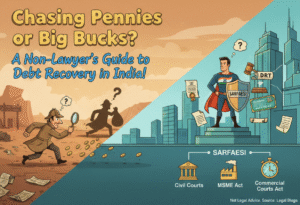
Chasing Pennies or Big Bucks? A Non-Lawyer’s Guide to Debt Recovery in India!
I. Introduction: The Age-Old Problem & India’s Modern Fight
Ever lent money and then felt like Sherlock Holmes trying to get it back? Or perhaps you’re a business staring down a mountain of unpaid invoices. Debt is a reality, alas, but so is its recovery!
Forget those “Wild West” debt collection stereotypes! India’s legal system, though structured (and at times, bewilderingly complex), offers creditors avenues to reclaim their dues. This isn’t about strong-arming; it’s about understanding your legal leverage. I wonder, though, if the average person truly understands the weight of their legal options?
We’ll explore the key laws, specialized courts, practical steps, frustrating challenges, and even recent court decisions that define debt recovery today. Consider this a layman’s cheat sheet to getting paid. I often find myself wishing for such clarity when sifting through legal jargon.
One should remember, this isn’t legal advice, merely a friendly exploration of the legal terrain, inspired by the insights of legal blogs like Credgenics and Ahlawat & Associates.
II. The Heavy Hitters: India’s Main Debt Recovery Laws
- A. SARFAESI Act, 2002: Banks’ “Take-No-Prisoners” Law
This is the big gun for banks and financial institutions concerning secured loans gone sour. They can seize and sell collateral without court intervention. A potent power, indeed! (Especially with the enhancements from the 2016 amendments).
Picture a bank taking possession of a mortgaged property after missed payments. That’s SARFAESI at work. I wonder if this seemingly unilateral power ever leads to injustices?
The Gujarat High Court recently shed light on the District Magistrate’s role: purely ministerial – they facilitate, not adjudicate. No dawdling permitted! Furthermore, the Gujarat High Court affirmed that secured creditors get first dibs on sale proceeds under SARFAESI Section 26E. I find this prioritization quite interesting.
- B. Recovery of Debts Due to Banks and Financial Institutions (RDDBFI) Act, 1993 & DRTs: The Bankers’ Own Courts
Debt Recovery Tribunals (DRTs) were established specifically for banks and financial institutions to recover substantial debts (exceeding ₹20 lakh). India hosts 39 DRTs and 5 DRATs (Appellate Tribunals), catering to these financial behemoths.
This is meant to be a quicker route than regular civil courts, though challenges remain (more on that later!). A 2024 High Court judgment explored whether DRTs can excuse delays in application filings, highlighting the procedural nuances these tribunals grapple with. One wonders, does this specialized approach truly expedite justice, or simply shift the bottlenecks?
- C. Insolvency and Bankruptcy Code (IBC), 2016: The Ultimate Corporate Reset Button
For companies (and even individuals/firms) financially overwhelmed, the IBC provides a comprehensive framework for resolution or liquidation. The aim? Maximizing asset value and ensuring timely resolution.
Creditors (financial or operational) can initiate insolvency proceedings if a company defaults on dues exceeding ₹1 crore. A significant threshold, wouldn’t you agree?
Crucially, the Delhi High Court (and subsequently the Supreme Court) has affirmed that once IBC proceedings commence and a moratorium is declared, banks cannot pursue SARFAESI proceedings against the same debt or personal guarantor. This puts a pause on everything, a much-needed respite, perhaps?
III. More Arrows in the Quiver: Other Important Recovery Avenues
- A. Negotiable Instruments Act, 1881: The Bounced Cheque Battle
This comes into play when a cheque bounces! Section 138 allows for criminal proceedings (yes, criminal!) following a legal notice, potentially leading to fines or even imprisonment. A civil recovery case can also be filed concurrently.
The Supreme Court recently clarified that cash debts over ₹20,000 are still legally enforceable under the NI Act, even if they violate income tax rules (overturning a Kerala High Court interpretation). This is undoubtedly welcome news for those who lend cash, but I wonder, what motivated the initial divergent interpretation?
- B. Code of Civil Procedure (CPC), 1908: The Traditional Courtroom Fight
For individual disputes, personal loans, or when other laws don’t apply, a civil suit is an option. Order XXXVII (Summary Suits) offers a faster route to recover clear-cut debts based on written contracts. Less fuss, less time! Legal blogs like Legodesk and Ahlawat Associates often detail how to navigate these civil remedies, emphasizing the need for solid documentation. I find the emphasis on documentation particularly crucial in these cases.
- C. MSMED Act, 2006: A Shield for Small Businesses
Micro, Small, and Medium Enterprises (MSMEs) receive special protection! If a buyer delays payment beyond 45 days, MSMEs can approach a Facilitation Council for arbitration, and delayed payments incur interest at three times the RBI’s bank rate. Ouch!
A 2024 High Court judgment underscored that an MSME borrower can’t suddenly claim MSME status to challenge SARFAESI proceedings if they didn’t raise it initially. This highlights the importance of knowing one’s status early on.
- D. Commercial Courts Act, 2015: Fast-Tracking Business Disputes
For significant commercial disputes (over ₹3 lakh), special Commercial Courts aim for quicker resolution, bypassing traditional delays.
IV. Navigating the Minefield: Practicalities, Challenges & Ethical Lines
- A. Starting Point: Amiable Approaches & Legal Notices
Most creditors begin with reminders, follow-ups, and negotiation. Often, it’s cheaper and quicker! If negotiations fail, a formal legal notice (15-30 days) is usually the next step, outlining the debt and intent for legal action. Legal blogs often emphasize this as a crucial procedural step.
- B. The Ticking Clock: Limitation Period
Generally, there’s a three-year window from the date the debt becomes due to file a recovery suit (Limitation Act, 1963). Miss it, and the claim might be legally unenforceable!
The Supreme Court has referred to a larger bench the complex question of whether time-barred debts can be recovered under special statutes, stemming from an appeal against a Punjab and Haryana High Court judgment. This demonstrates the crucial and debated nature of the time limit.
- C. The Roadblocks: Why it’s Not Always Easy
Despite specialized tribunals, cases can drag on for years. Overloaded dockets, staff shortages, and infrastructure issues contribute. The iPleaders blog often covers these systemic challenges. Even after obtaining a judgment, actually recovering the money can be difficult if the debtor has no traceable assets or has absconded.
Debtors sometimes exploit loopholes or initiate parallel proceedings to delay the process. I wonder if there’s a way to streamline procedures to minimize these delays.
- D. Drawing the Line: Ethical Debt Collection
The Reserve Bank of India (RBI) has strict guidelines for banks and financial institutions. No harassment, threats, or calls outside 7 a.m. to 7 p.m.! Borrowers also have rights, including privacy and protection from unfair practices. The Lawyer Panel blog specifically highlights rights against harassment.
In a stark reminder, the Madras High Court in April 2025 convicted a recovery officer of the DRT Madurai for conspiring to undervalue properties in auctions, labeling them “white-collar criminals.” A clear message about upholding public trust!
V. Game-Changing Judgments: High Courts Shaping the Future
- Borrower’s Redemption Right: In a significant September 2025 ruling (M. Rajendran v KPK Oils and Proteins India Pvt. Ltd.), the Supreme Court held that a borrower’s right to redeem a secured asset under SARFAESI is extinguished upon the publication of the auction sale notice, not just at sale confirmation. High Courts shouldn’t interfere if there’s an alternative SARFAESI remedy. What implications does this have for borrowers facing financial distress?
- DM’s Powers: The Supreme Court (upholding a Bombay High Court decision) reiterated that Chief Metropolitan Magistrates (CMM) or District Magistrates (DM) have only ministerial powers under SARFAESI Act Section 14. They can’t adjudicate borrower objections; they just help banks take possession.
- SARFAESI vs. BUDS Act: The Kerala High Court clarified that SARFAESI or IBC actions remain valid even if claims under the Banning of Unregulated Deposit Schemes (BUDS) Act, 2019, are present. Secured creditors generally have priority.
VI. Conclusion: Arm Yourself with Knowledge!
Debt recovery in India is an intricate and evolving landscape, offering various paths depending on the specifics of the debt.
Understanding these laws and the available forums (civil courts, DRTs, NCLT, MSME Councils) is vital for both creditors and debtors.
Given the complexities, legal blogs (like those cited from ibclaw.in and sscrana.in) consistently advise seeking expert legal guidance to navigate this complex terrain effectively. Know your rights, explore your options, and pursue what is rightfully yours!
Disclaimer: This blog post provides general information and should not be considered legal advice. Always consult a qualified legal professional for your specific situation.
