


Navigating the Murky Waters of Matrimonial Cruelty in India: What You Need to Know
Navigating the Murky Waters of Matrimonial Cruelty in India: What You Need to Know
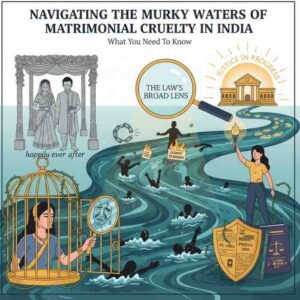
I. Hook: More Than Just “Happily Ever After” – The Hidden Reality of Matrimonial Cruelty
Marriage, particularly in India, is often presented as this idyllic union, a seamless blend of two souls culminating in a “happily ever after.” But I often wonder, as a legal professional, how much of this narrative holds true when I encounter cases that paint a drastically different picture – a battleground concealed behind closed doors. It makes one ponder, doesn’t it? We’re not talking about the visible scars, the obvious instances of physical violence, but the far more insidious wounds – the emotional and psychological ones.
The numbers are frankly, unsettling. If you look at the official statistics, you’ll find over 1.3 lakh cases registered annually under the umbrella of “cruelty by husband or relatives.” This data, often cited from sources like the NCRB reports (available through Lawblend.com), suggests this isn’t some anomaly; it’s a pervasive reality lurking beneath the surface of our society.
So, what I want to delve into, and perhaps you’ll find this enlightening as well, is the legal definition of “cruelty” within the Indian context. What are the specific laws designed to offer protection? What are the inherent challenges in their application? And, most importantly, how are our courts – the interpreters of justice – constantly shaping and refining our understanding of this concept? Let’s embark on this legal exploration together, shall we?
II. What Even IS “Cruelty” Anyway? The Law’s Broad Lens
When we talk about “cruelty” in a legal context, especially within matrimonial disputes, it’s crucial to understand that it extends far beyond a simple act of physical violence. Indian law, commendably, adopts a more comprehensive approach, recognizing the significant, and often devastating, impact of what might be termed “invisible wounds.”
There are, broadly speaking, two primary definitions that shape our understanding:
First, there’s the kind of conduct that is likely to drive a person to commit suicide or cause grave injury, either physical or mental. Now, this is a pretty high bar, isn’t it? But think about the implications. Relentless emotional torture, a constant barrage of humiliation, systematic degradation – these could all fall under this definition. You’ll find this aspect addressed within the explanation attached to Section 498A of the Indian Penal Code (IPC), and legal platforms such as DrishtiJudiciary.com offer excellent insights into its interpretations.
Secondly, and sadly still very relevant, there’s the issue of harassment related to unlawful demands for property, more commonly known as dowry. Despite being outlawed, this practice continues to cast a long shadow over many marriages, and any form of harassment connected to it is unequivocally considered cruelty under the law. (IPC 498A)
But beyond these statutory definitions, judicial interpretations have fleshed out the concept of cruelty even further, acknowledging its many different forms.
- Physical Cruelty: This is the most straightforward – overt acts of violence such as hitting, slapping, or any form of physical assault.
- Mental/Emotional Cruelty: Ah, this is where it gets complex. These are the silent killers – gaslighting, constant insults, public humiliation, emotional neglect, isolation from family and friends. These acts often leave no visible marks, but their impact can be just as, if not more, devastating. Cases like Samar Ghosh v. Jaya Ghosh (2007) and K. Srinivas Rao v. D.A. Deepa (2013), both landmark Supreme Court decisions, have significantly broadened the scope of what constitutes mental cruelty.
- Financial Cruelty: This involves controlling finances, denying access to funds, or forcing a spouse into debt against their will. The Protection of Women from Domestic Violence Act (PWDVA) 2005 acknowledges this form of abuse.
- Sexual Cruelty: This can involve the unjustified denial of conjugal rights or forcing a spouse to engage in unwanted sexual acts. Samar Ghosh v. Jaya Ghosh touched upon this aspect as well.
- False Accusations: And here’s a fascinating twist. Making baseless accusations against a spouse, particularly accusations that could damage their reputation or career, can itself be considered mental cruelty! This principle was highlighted in cases like Narendra v. K. Meena (2016), and a recent ruling by the Delhi High Court on September 16, 2025, further emphasized this point.
III. Your Legal Shield: The Key Laws in Play
So, what legal recourse is available if one finds themselves in such a situation? Well, thankfully, Indian law provides several avenues for seeking protection and redressal.
A. Section 498A IPC: The Criminal Heavy Hitter
This is often the first law that comes to mind when discussing matrimonial cruelty. What is it? It’s essentially the primary criminal law used to address cruelty inflicted by a husband or his relatives. The punishment can be up to 3 years in jail, along with a fine. (IPC 498A, AdvocatesClub.in)
And what’s the nature of the offense? It’s cognizable, meaning the police can arrest the accused without a warrant. It’s also non-bailable, making it difficult to obtain bail easily, and non-compoundable, meaning the case cannot be settled out of court through a compromise. (Lawcrust.com)
Who can be accused? The husband and his relatives – this includes parents, siblings, and other in-laws. (AdvAmritaVerma.com)
It’s also worth noting that IPC 498A is slated to transition to Section 85 of the Bharatiya Nyaya Sanhita (BNS) 2023 from July 1, 2024. From what I gather from the publicly available information from the MHA.gov.in, the core protections remain largely the same.
B. The Protection of Women from Domestic Violence Act (PWDVA), 2005: Broader Civil Relief
This Act is broader in scope than Section 498A. It protects not just wives but also live-in partners, mothers, sisters – essentially anyone in a domestic relationship. (LawBlend.com)
The definition of “domestic violence” under this Act is also quite wide-ranging, encompassing physical, sexual, verbal, emotional, and economic abuse, as well as dowry harassment.
Furthermore, the PWDVA offers immediate relief, including protection orders (to stop the abuse), residence orders (ensuring the right to stay in the shared home), monetary relief, and even child custody arrangements. (SarabLegalSolutions.com)
C. Cruelty as a Ground for Divorce: When Marriage Breaks Down
Under the Hindu Marriage Act, 1955 (Section 13(1)(ia)), both the husband and wife can seek a divorce based on cruelty. (LawBhoomi.com)
Similar provisions exist in other personal laws as well, such as the Dissolution of Muslim Marriage Act, 1939, for Muslims, the Parsi Marriage and Divorce Act, 1936, for Parsis, and the Special Marriage Act, 1954, for those who choose to marry outside their religious affiliations.
IV. When Courts Step In: Landmark Judgments & High Court Insights
The courts, of course, play a vital role in interpreting and applying these laws. Several landmark judgments have significantly shaped our understanding of matrimonial cruelty.
Supreme Court Setting the Tone:
- Dastane v. Dastane (1975): This case established the principle that mental cruelty is indeed a valid ground for divorce. It also clarified that proof of cruelty should be based on the “preponderance of probabilities” rather than the stricter standard of “beyond a reasonable doubt” used in criminal cases.
- Samar Ghosh v. Jaya Ghosh (2007): This case provided a detailed list of examples of what could constitute mental cruelty, including refusal of sexual relations, emotional detachment, and false complaints. (SCCOnline.com)
- K. Srinivas Rao v. D.A. Deepa (2013): The court ruled that filing a false 498A case against a spouse could, in itself, be considered an act of mental cruelty.
- Narendra v. K. Meena (2016): The Supreme Court held that alienating a spouse from their parents could also amount to mental cruelty.
- Recent Clarification (Sept 26, 2025): Most recently, the court clarified that, in the context of Section 498A, the cruelty must involve an intent to cause grave injury or drive the victim to suicide. Vague allegations are not sufficient. (LiveLaw.in, ThePrint.in)
High Courts Echoing & Expanding:
- Delhi High Court: The Delhi High Court has consistently held that public humiliation, verbal abuse, and parental alienation (turning a child against a parent) all constitute mental cruelty. (Delhi High Court Ruling, July 22, 2025 & Sept 26, 2025, Gavel.io)
- Kerala High Court: The Kerala High Court has emphasized that cruelty isn’t just about physical danger; mental suffering or fear experienced in marital life is also a valid consideration. They have even stated that forcing a spouse to adhere to specific spiritual practices against their will can be considered cruelty. (LawBhoomi.com)
- Patna High Court (Sept 19, 2025): The Patna High Court recently stressed the importance of judging cruelty based on the actual agony inflicted on the spouse, rather than some abstract or “ideal” standard of behavior. (Lawbeat.in)
- Chhattisgarh High Court: The Chhattisgarh High Court has ruled that persistent ill-treatment, humiliation, and emotional neglect that lead to severe psychological suffering are valid grounds for seeking legal recourse. (LawBhoomi.com)
V. The Double-Edged Sword: Challenges and Misuse
Now, let’s consider the challenges. This area of law is not without its complexities and potential for misuse.
- Underreporting: A significant challenge is the underreporting of cases. Many individuals, particularly women, suffer in silence due to social stigma, family pressure, or economic dependence. (FeminismInIndia.com)
- Proving the Invisible: Proving mental cruelty can be particularly difficult. It often requires gathering substantial evidence, such as text messages, witness testimonies, or medical records documenting the psychological impact of the abuse. (Ipleaders.in)
- The “Misuse” Debate: Courts, including the Supreme Court in cases like Rajesh Sharma v. State of U.P. (2017), have raised concerns about the potential for misuse of Section 498A. There have been instances of false cases being filed, allegations being exaggerated, and the law being used as a tool for revenge or leverage in divorce and maintenance battles.
- Why it happens: Sometimes, it’s driven by a desire for retribution or as a bargaining chip in divorce proceedings.
- The Impact: This can lead to the harassment of innocent family members, dilute the credibility of genuine complaints, and erode trust in the legal system. (Economictimes.com)
- Yes, Husbands Too!
- It’s crucial to remember that cruelty is not a gender-exclusive phenomenon. Husbands can also be victims of mental cruelty (false accusations, emotional abuse from wives or in-laws) and can seek a divorce on these grounds under the Hindu Marriage Act, 1955. (Lawblend.com)
- They can also file criminal complaints under other sections of the IPC for instances of physical violence (such as Sections 323 for causing hurt or 506 for criminal intimidation). (Unacademy.com)
VI. Seeking Justice: Your Path Forward
If you believe you are a victim of matrimonial cruelty, here are some steps you can take:
- Know Your Rights: This blog post is a starting point, but seeking professional legal advice is crucial.
- Steps to Take (if you’re a victim):
- Criminal Complaint: File a First Information Report (FIR) under Section 498A IPC at the local police station.
- Civil Remedies: File an application under the PWDVA to a Magistrate, seeking protection orders, residence orders, and monetary relief.
- Divorce Petition: File for divorce on the grounds of cruelty under the applicable personal laws.
- Support Systems:
- Consult lawyers specializing in domestic violence cases. Legal directories such as AdjuvaLegal.com and Vidhikarya.com can be helpful resources.
- Reach out to organizations like the National Commission for Women (NCW) and the National Legal Services Authority (NALSA), as well as various NGOs that provide support to victims of domestic violence.
- Consider mediation, as family courts often encourage this approach to facilitate amicable settlements.
VII. The Bottom Line: Justice in Progress
The legal landscape surrounding matrimonial cruelty in India is constantly evolving. Courts are increasingly recognizing the diverse forms that cruelty can take, reflecting a greater awareness of the complexities of marital relationships and societal realities.
Staying informed about your rights and the available legal remedies is crucial. And remember, you don’t have to suffer in silence. The legal provisions are there to help, but understanding them is the first step towards seeking justice and reclaiming your life.